Licensed music in film and tv can often be used because it sounds good, fitting the scene’s tone or style, or maybe just because it works. But I was recently reading an article that discussed how a “pop song” (or really any pre-existing piece of music) can imbue a film with additional layers or meanings: what I’ll refer to as “extratextual meaning”.
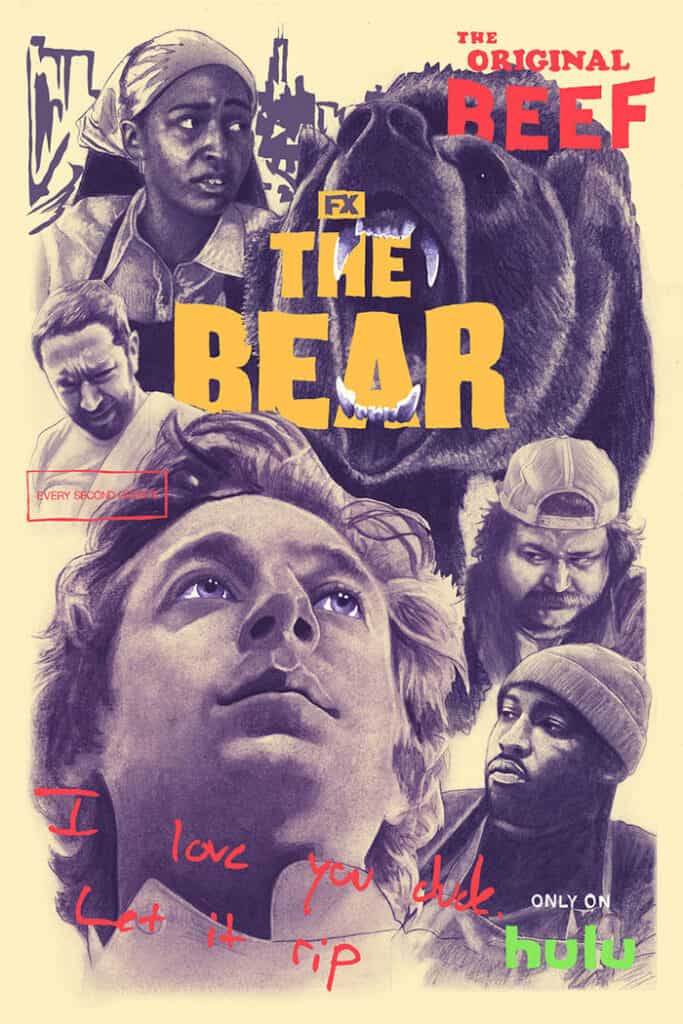
For example, near the beginning of Episode 8 of Season 4 of The Bear we hear the song “I Got You Babe” by Sonny & Cher. Why? The episode starts with a nightmare sequence, where one of the main characters, Sydney, is being pummeled by the fears and anxieties ever-present in her job. Her alarm goes off – an alarm clock, not a phone alarm– she wakes up, and “I Got You Babe” plays. Of course, the pairing of “I Got You Babe” and an alarm clock blaring were made famous in 1993’s Groundhog Day, with the combination signaling the start of the day in Bill Murray’s time loop. In one second, then, we infer that Sydney is going through a similar time loop: the nightmares, worries, and stresses from her job repeat every day without fail. The show could have used a montage or expository dialogue to get the same point across, but every second matters, and this shorthand saves plenty.
But this extratextual meaning isn’t limited to plot points or exposition. Take The Darjeeling Limited. The film follows three estranged brothers constantly in conflict. Those viewers with some musical knowledge may then tie the use of several songs from The Kinks to this premise – just as the brothers in The Darjeeling Limited fight, so too did the brothers in The Kinks. It’s a simple little device that adds to the film’s themes and characterization.
This extratextual meaning might not necessarily be replicable through the use of original score alone, especially when it’s a piece of score not previously used within that project (more on this later). After all, a score in a non-franchise film exists only within that film; what the score means to us comes only from what we’ve already seen.
However, thematic use within a score can have a similar impact. Repetition of a theme builds on its prior uses, our minds consciously or subconsciously drawing upon and remembering them. While not exactly extratextual – its meaning is still derived from the film, the “text” – the viewer is nonetheless pulling meaning from beyond the present moment.
This effect is strengthened when we hear recurring musical themes across films in a franchise. As a result, multiple films’ worth of meaning are ascribed to these themes, and of course more frequent use of a given piece of music also increases the meaning it has to an audience member. After all, it’s easy for a casual filmgoer to not consciously notice a theme, particularly one that is more textural, and again, repetition increases recognition.
It’s probably safe to assume that the more easily a score is recognized within a film, the more likely it is to have a life outside of the film as well. Take John Williams’ main theme from Jaws, which has undeniably spread throughout mainstream life; anyone, anywhere hearing a snippet of that theme will instantly feel danger, whether it be from a shark or, well, anything at all. When a theme has this broader cultural impact, or is used outside of films, subsequent uses can also draw on those memories, experiences, and meanings. Going back to Jaws, Jackie Chan’s First Strike briefly quotes that theme in a comedic misdirection when it appears that Jackie is about to be eaten by a shark (though I don’t recall whether that reference is in the U.S. or Hong Kong score for the film, as each territory had a difference composer).
This brings to mind the seeming lack of musical or thematic continuity in more recent film franchises. Take the MCU as an example. One of the long-standing complaints of the franchise is the lack of musical continuity: some themes and composers persist, while others are swapped out mid-series. The Avengers’ theme is probably the most notable from the franchise, but that’s as much to do with the memorability of the melody as it is how frequently it was used throughout countless MCU entries. Again, repetition. But what other themes persist?
Now, this isn’t a novel observation about the MCU’s music, but it serves as a good example. Directors often change from one character’s film to the next, and new musical themes allow them to put their own stamp on a film rather than being bound by prior entries (and in major franchises, there are already enough creative constraints). But in doing so it removes cross-film meanings, serving as a partial reboot of a character, no different than if James Bond started ordering white Russians instead of vodka martinis.
It also raises the question of why older themes are being snuck into new projects. For example, Michael Giacchino drops his raptor theme from his score for the 1997 game The Lost World into his score for 2022’s Jurassic World Dominion. Similarly, Zach Robinson and Leo Birenberg told me how fans thought that they had snuck some older Marvel character themes into Your Friendly Neighborhood Spider-Man (they hadn’t). They’re fun little easter eggs, but are they any more than that? Is there a broader narrative or character reason, or is it just a musical version of a character cameo?
A recent film that went halfway was James Gunn’s Superman. The score significantly featured John Williams’ iconic Superman theme, but still shied away from using it in its entirety. A single quote would be an homage, without much narrative meaning but relatively harmless. Using it fully and repeatedly would connect itself fully to the Donner Superman films, drawing on that character, Reeves’ portrayal, and the theme’s broader cultural impact, thereby making the film seem like a continuation of those prior films. But quoting it often without fully committing leaves it in a strange middle ground: the Donner and Williams connection is there, but it serves little meaning, particularly when the film is meant to be a fresh start (though studio interference in the score could be to blame…).
Something that Jeff Danna recently told me may explain some of this. He said that using themes for characters can be a risk not just for the composer but also for the filmmaker (or showrunner, etc.): once the choice is made, the theme and the character become indefinitely intertwined, the theme imbued into the character like a tattoo. The assumed permanency of the decision is a risk – if it’s bad, if the audience doesn’t connect with it, if it doesn’t fit with future plans for a character, then you’re stuck with a decision that harms the character and the project.
But what if you can just change the theme, what if there is no permanency? When there is no permanence, when everything becomes ephemeral, then there is no risk. In that way it’s similar to the use of licensed music, which is often a risk-free affair, but without any of the extratextual meaning.